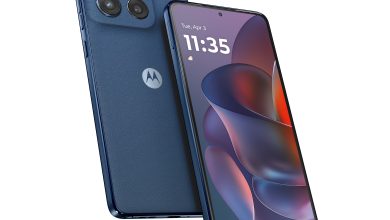
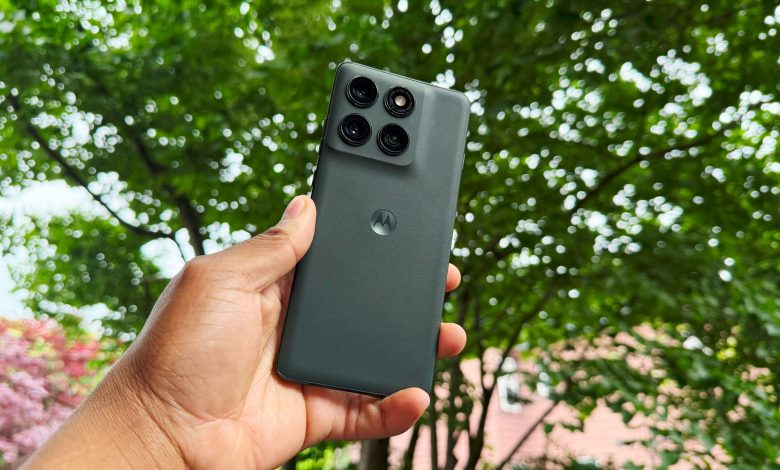
The 2025 Motorola Edge is a mid-range smartphone that looks premium but performs modestly. With a striking design, solid build quality, and decent cameras, it’s a good-looking phone—but its underpowered chipset and mediocre performance hold it back from greatness.
Key Takeaways
- Stunning Design – Curved Gorilla Glass 7i + vegan leather back, IP68/IP69 water/dust resistance, MIL-STD-810H durability.
- Good Camera Setup – 50MP main + 50MP ultrawide + 10MP telephoto (3X zoom).
- Solid Battery & Charging – 5,200mAh battery, 68W wired charging (53 min full charge), 15W wireless.
- Weak Performance – Mediatek Dimensity 7400 lags behind rivals.
- Reflective Display – No anti-glare coating, hard to use outdoors.
- Aggressive Image Processing – Oversharpening reduces photo quality.
Design & Build: A Beauty with Brawn
- Deep Forest green vegan leather back (Pantone-validated).
- Dual-curved Gorilla Glass 7i display (feels like a Galaxy S8).
- IP68/IP69 + MIL-STD-810H (dust/water/shock resistant).
- Dedicated AI button (quick access to Perplexity AI features).
Verdict: One of the best-looking mid-range phones, but the reflective screen is annoying.
Display: Smooth but Glare-Prone
- 6.7″ FHD+ OLED, 120Hz refresh rate, HDR10+.
- Peak brightness: 1,400 nits (good, but reflections hurt visibility).
- In-display fingerprint sensor (decent, not the fastest).
Comparison:
| Phone | Peak Brightness | Anti-Reflective Coating? |
|---|---|---|
| Motorola Edge (2025) | 1,400 nits | ❌ No |
| Pixel 9a | 1,900 nits | ✅ Yes |
| Galaxy A56 5G | 1,700 nits | ✅ Yes |
Verdict: Good colors & smoothness, but outdoor visibility suffers.
Performance: The Biggest Letdown
- Mediatek Dimensity 7400 (4nm, mid-range performance).
- 8GB RAM + 256GB UFS 2.2 storage (slow for 2025).
- Struggles with multitasking & gaming.
Benchmarks (vs. Competitors)
| Test | Moto Edge (2025) | Pixel 9a | Galaxy A56 5G | iPhone 16e |
|---|---|---|---|---|
| Geekbench 6 (Single) | 1,085 | 1,687 | 1,361 | 3,166 |
| Geekbench 6 (Multi) | 3,056 | 4,385 | 3,894 | 7,763 |
| 3DMark Extreme | 1,016 | 2,625 | 1,322 | 3,017 |
Verdict: Worse than rivals—fine for social media, bad for gaming/heavy apps.
Cameras: Decent but Overprocessed
- 50MP main (f/1.8) – Good detail, but oversharpening.
- 50MP ultrawide – Decent, but soft edges.
- 10MP 3X telephoto – Surprisingly sharp for a mid-ranger.
- 50MP selfie – Overprocessed skin tones.
Video:
- 4K @ 30/60fps (but no lens switching in 4K).
- 1080p allows switching, but quality drops.
Verdict: Good hardware, but software holds it back.
Battery & Charging: A Bright Spot
- 5,200mAh battery → 6h 45min screen-on time (average).
- 68W wired charging → 70% in 30 mins, full in 53 mins.
- 15W wireless charging (nice for a mid-ranger).
Comparison:
| Phone | Battery Life | Charging Speed |
|---|---|---|
| Moto Edge (2025) | 6h 45min | 68W (53 min full) |
| Pixel 9a | 8h 11min | 30W (80 min full) |
| Galaxy A56 5G | 7h 3min | 25W (90 min full) |
Verdict: Fast charging, but battery life is just okay.
Software & AI Features
- Near-stock Android 15 (clean & smooth).
- Moto Actions (twist for camera, chop for flashlight).
- Perplexity AI integration (via dedicated button).
- Google Gemini support (Circle to Search, Live Translate).
Verdict: Clean software + useful AI, but performance limits usability.
Should You Buy It?
Buy If:
- You love the design & don’t need top-tier performance.
- You want fast charging + wireless charging at this price.
- You prefer clean Android with useful AI features.
Skip If:
- You game or multitask heavily (get a Pixel 9a instead).
- You hate glare (the screen is very reflective).
- You prioritize camera quality (oversharpening is annoying).
Alternatives:
- Google Pixel 9a ($499) – Better performance, camera, battery.
- Samsung Galaxy A56 5G (~$550) – Better display, performance.
- iPhone 16e ($599) – Much faster, but worse camera & storage.
Final Verdict: 6.5/10
The Motorola Edge (2025) is a great-looking mid-ranger with solid battery life & charging, but its weak chipset and reflective screen make it hard to recommend over rivals.
For $550, you’re paying for style—not speed.